Bombay’s little-known role in India’s Independence movement
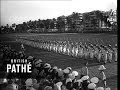
The last British troops parade in Bombay. (AP Photo)




On 15 August 1947, when independent India’s first
prime minister, Jawaharlal Nehru, delivered his famous “Tryst with
Destiny” speech in Parliament House, New Delhi, a parallel celebration
was unfolding in Bombay.
The chief minister of the erstwhile Bombay State,
Balasaheb Gangadhar Kher, unfurled the Indian tri-colour at the Bombay
Civil Secretariat—today the City Civil and Sessions Court, across from
the Oval Maidan. His words, though not as memorable as Nehru’s, declared
to the assembled crowd: “Citizens of Free India, you are now free.”
Perhaps not too many people caught those words in a city besieged by crowds celebrating for two full days.
Two days later, by August 17, the first
battalions of British troops began embarking ships at Ballard Pier in
south Bombay, to leave Indian shores forever.
It was a moment of profound symbolism. Bombay was
the first British Royal Possession (territory) on the Indian
subcontinent. Though the original seven islands were gifted in dowry to
King Charles II of England when he married the Portuguese princess
Infanta Catarina de Bragança in 1661, the “gift” had to be wrested from
the islands’ resident Portuguese community, which was reluctant to let
go.
By 1665, a special royal expeditionary force
occupied the islands, and Bombay became England’s first territorial
acquisition on the subcontinent. Bombay was the first British Royal Possession (territory) on the Indian subcontinent.
But the British rulers at the time had not yet
recognised the geopolitical and geoeconomic significance of the location
of the islands. To them, it seemed that Bombay and its surroundings
were hopelessly located for trade and ill-equipped even to feed a
resident population. The city’s deep and spacious harbour was deemed
unsuitable because it was isolated from the main overseas trade routes
that culminated at the Mughal êntreport of Surat, located north of
Bombay.
It must therefore have been with some relief that
the Crown leased the islands to the East India Company for an annual
rent of £10 in 1668. Eventually, the strategic importance of Bombay by
the late 18th and early 19th centuries
as an êntreport, the capital of a Presidency named after it, and the
headquarters of the Royal Indian Navy, made it the nerve centre of the
Indian nationalist movement.
And the city helped to hasten the departure of
Britain from its most cherished colony—India. Many milestones of the
country’s struggle for Independence were launched from Bombay—the
founding of the Indian National Congress (1885); Mahatma Gandhi’s early
residence in the city at Mani Bhavan on Laburnum Road;, the launch of
the Non-Cooperation Movement (1920-1922) and the Khilafat Movement (1919-1924); and the Quit India Movement of 8 August 1942.
The Royal Indian Naval uprising in Bombay
However, what really accelerated Britain’s exit
from India was the mutiny of sailors of the Royal Indian Naval (RIN)
from 18 to 25 February, 1946, in Bombay—a moment in history that is
marked by the Indian Navy’s “Naval Uprising Memorial” in Colaba.
British colonialism’s rule in South Asia, as
elsewhere across the world, depended greatly on the British-Indian armed
forces. When the British government could no longer depend on these
forces to enforce its rule, it was a turning point.
The mutiny began innocuously, with a thousand
sailors going on a flash sit-down and hunger strike aboard signal
training ship, HMIS Talwar on the morning of February 18. The headline
of the Times of India of 19 February 1946 stated: “Indian
Ratings on Strike in Bombay: Better Conditions Demanded.” But in
reality, the simmering tensions had much deeper roots.
It is the timing of this mutiny that explains why
it spread like wildfire across every branch of the armed services. Not
just across naval ships anchored in Bombay harbour (some of them raised
Congress flags), but also across every major naval establishment
(Karachi, Calcutta, Visakhapatnam, Cochin, Lonavala, and even New
Delhi), Royal Indian Air force stations (Sion, Madras, Kanpur, and
Ambala), and even army units in Bombay, Karachi, and Calcutta. Indian soldiers were sent into a war that India did not want to fight.
It was a time when World War II (1939-1945) had
just ended. Indians had been reluctantly dragged into the war—this was
unlike the support of nationalist parties for Great Britain during World
War I (1914-1919). This time, despite negative public opinion, Indian
soldiers were sent into a war that India did not want to fight.
Post-war tensions were further complicated by the
unequal terms on which British and Indian military personnel were
demobilised or let off. British troops were given better perks and pay,
while Indian troops faced losing their livelihood on patently unfair
terms.
Another important factor was the ongoing trial at
the time of soldiers of Subhash Chandra Bose’s Indian National Army
(INA) at the Red Fort in Delhi. Many Indian army soldiers were captured
by the Japanese army in theatres of war across Burma and Southeast Asia.
Many of these prisoners of war chose to join Bose’s INA in Singapore,
which had been formed and financed by expatriate Southeast Asian Indians
to free India from British rule.
The court martial of roughly 23,000 INA soldiers
for high treason, especially of the “Big Three”—Major General Shah Nawaz
Khan, Colonel Prem Sahgal, and Colonel Gurbaksh Singh Dillon—created
great unease among the Indian armed forces.
It culminated in the RIN mutiny of 1946.
The high point of the mutiny came on February 21,
when, for the first time in Indian naval history, the guns of the RIN
warships were trained on the city itself. It was only in the evening
that the mutineers hoisted the ceasefire flag.
The mutiny was called off on February 25, after Vallabhbhai Patel and Nehru intervened.
Coincidentally, it was during the week of the RIN
mutiny that British prime minister Clement Atlee announced that he
would send a Cabinet mission to India to break the deadlock for setting
up the Indian Constituent Assembly. The arrival of this last cabinet
mission began the countdown to Indian Independence.
This post first appeared on Gateway House............................................................................................................................
story behind Britain’s hasty exit from India
the original plan was for British Government to grant full self-government to British India by June 1948
but British got scared by revolt in indian navy at bombay
revolt in indian army in other places in India, and Indian air force Bombay
[1]Royal Indian Navy mutiny - Wikipedia, the free encyclopedia
https://en.wikipedia.org/wiki/Royal_Indian_Navy_mutiny
\
[2]Indian National Army trials - Wikipedia, the free encyclopedia
https://en.wikipedia.org/wiki/Indian_National_Army_trials
The sailors were also joined by RIAF[ROYAL INDIAN AIR FORCE] personnel from Andheri and Marine Drive camps.
The gurkhas serving in Karachi disobeyed orders to fire on these sailors.
The strike spread to Vizag and Kolkata as well.
During the trial, mutiny broke out in the Royal Indian Navy, incorporating ships and shore establishments of the RIN throughout India from Karachi to Bombay and from Vizag to Calcutta. The most significant if disconcerting factor for the Raj was the significant militant public support that it received. At some places, NCOs in the British Indian Army started ignoring orders from British superiors. In Madras and Pune, the British garrisons had to face revolts within the ranks of the British Indian Army.
Another Army mutiny took place at Jabalpur during the last week of February 1946, soon after the Navy mutiny at Bombay. This was suppressed by force, including the use of the bayonet by British troops. It lasted about two weeks. After the mutiny, about 45 persons were tried by court martial. 41 were sentenced to varying terms of imprisonment or dismissal. In addition, a large number were discharged on administrative grounds. While the participants of the Naval Mutiny were given the freedom fighters' pension, the Jabalpur mutineers got nothing. They even lost their service pension.
Reflecting on the factors that guided the British decision to relinquish the Raj in India, Clement Attlee,
 the then British prime minister,
cited several reasons, the most important of which were the INA
activities of Netaji Subhas Chandra Bose, which weakened the Indian Army
- the foundation of the British Empire in India- and the RIN Mutiny
that made the British realise that the Indian armed forces could no
longer be trusted to prop up the Raj.[3]
the then British prime minister,
cited several reasons, the most important of which were the INA
activities of Netaji Subhas Chandra Bose, which weakened the Indian Army
- the foundation of the British Empire in India- and the RIN Mutiny
that made the British realise that the Indian armed forces could no
longer be trusted to prop up the Raj.[3]Although Britain had made, at the time of the Cripps' mission in 1942, a commitment[4] to grant dominion status[5] to India after the war this suggests that, contrary to the usual narrative of India's independence struggle, (which generally focuses on Congress and Mahatma Gandhi), the INA and the revolts, mutinies, and public resentment it germinated were an important factor in the complete withdrawal of the Raj from India.
Most of the INA. soldiers were set free after cashiering and forfeiture of pay and allowance.[6] On the recommendation of Lord Mountbatten of Burma, and agreed by Nehru, as a precondition for Independence the INA soldiers were not reinducted into the Indian Army.

Did you know that you can earn cash by locking special pages of your blog or site?
ReplyDeleteAll you need to do is open an account on CPALead and use their Content Locking tool.