Five places in Mumbai that were part of India's freedom struggle

Five places in Mumbai that were part of India's freedom struggle

Saturday, 15 August 2015 - 8:46am IST | Agency: dna | From the print edition

dna profiles five of the most prominent places of Mumbai which have been part of India's freedom struggle.
  • freedomSalman Ansari dna
The growth of political consciousness in Mumbai started after the establishment of the Bombay Presidency Association byDadabhoy Nauroji on January 31, 1885. Then, the partition of Bengal in 1905, which initiated the Swadeshi movement, had a tremendous impact on Bombay. This intensified on July 22, 1908, when Lokmanya Tilak, who was spearheading the Swadeshi movement in Bombay, was sentenced to six years' imprisonment; there were huge protests across the city.
Five years later, in April 1913, Congress leader Pherozeshah Mehta started The Bombay Chronicle, a newspaper which played an important role in the national movement till India's Independence.
However, the most important event in Bombay early in 1915 was Mahatma Gandhi's visit, which led to mass movement in support of the freedom struggle.
dna profiles five of the most prominent places of Mumbai which have been part of India's freedom struggle.
Bombay Harbour: Where the most spectacular revolt against the British rule took place
The Royal Indian Navy Mutiny of February 18, 1946, at Bombay Harbour marked the first and most serious revolt by Indian sailors against the British rule. Shipmen posted at HMS Talwar announced a strike to oppose the Raj. The next day, they took over the naval trucks and started patrolling the city, inviting the masses to join in the struggle. Union Jacks were torn down and the rebels hoisted red flags. Within 48 hours the revolt spread to 74 ships, 20 fleets and 22 units of the navy along the coast of Calcutta, Karachi, Madras, Cochin and Vishakhapatam.
Despite widespread effect, the revolt failed to get the political backing. On February 22-23, over 250 sailors were killed by the imperialist forces. Strikers were forced to surrender. Most of them were executed later. However, after the navy uprising, the British prime minister announced that the British would leave India before June 1948.
Gowalia Tank Maidan: The place of the Quit India resolution where the Tricolour was first hoisted
On July 14, 1942, the Indian National Congress passed a resolution demanding complete freedom to the nation from the British. On the intervening night of August 8-9, 1942, the Congress passed the famous 'Quit India resolution', which electrified the country. This has become the popular 'Quit India Movement', and the mass civil disobedience movement was launched with Mahatma Gandhi's "do or die" call.
The British police treated the masses brutally. At that time, Aruna Asaf Ali hoisted the Tricolour on the Gowalia Tank Maidan proudly, which was a first.
Within a few hours of the resolution and call, all national leaders were arrested. As there were no leaders outside, the movement became violent. The British government moved the army and more than 1 lakh people were arrested. All leaders and freedom fighters who participated in the movement were released only after three years, after World War II ended.
Gokuldas Tejpal Sanskrit Pathshala: The place where foundation of the Congress took place
The foundation of the Indian National Congress in 1885 was one of the most important political events in Bombay. On December 28, 1885, delegates gathered at Gokuldas Tejpal Sanskrit Pathshala, near Gowalia tank, to form the INC, with WC Bannerjee in the chair and AO Hume assuming office as the general secretary. Other important delegates included Dadabhai Naoroji, Justice Ranade, Pherozeshah Mehta and Dinshaw Wacha.
The first session of the Indian National Congress was held from December 28 to 30 in the school. The Congress was created by British rulers to form a platform for civic and political dialogue of educated Indians, especially after the transfer of India from the East India Company to the British Empire.
Mani Bhawan: The place where Mahatma Gandhi stayed and launched many movements
Located on Laburnum Road in Gamdevi, this serene two-story building was Mahatma Gandhi's home from 1917 to 1934. If these walls could speak, they would talk about the many important movements against the British rule that were launched from here — the Satyagraha movement, the Swadeshi movement, meetings to launch the Civil Disobedience Movement, as well as Gandhi's fasts for peace.
Today, it is an ode to Gandhi and to all things Gandhian. You can see photos of the freedom struggle and some of Gandhi's personal life; you can hear his speeches on earphones, and read his letters, you can also see his personal possessions. Mani Bhavan also houses a reading library.
Gateway of India: From where the last British troops left India
The Gateway of India was erected to commemorate the landing of British King George V and Queen Mary at Apollo Bunder. The governor of Bombay, Sir George Sydenham Clarke, laid its foundation on March 31, 1911, after getting the final design from George Wittet. The construction was finished in 1924.
Ironically, this is the place through which the last British troops left India, marking the end of British rule on February 28, 1948. The last British serving battalion, the first Somerset Light Infantry, embarked from Bombay on the morning of February 28 on the 'Empress of Australia' on their voyage home after receiving guards of honour by crack contingents of the Indian Army.

Bombay’s little-known role in India’s Independence movement-by samuel lentin[the films added by me]


Tryst with destiny

Bombay’s little-known role in India’s Independence movement


On 15 August 1947, when independent India’s first prime minister, Jawaharlal Nehru, delivered his famous “Tryst with Destiny” speech in Parliament House, New Delhi, a parallel celebration was unfolding in Bombay.
The chief minister of the erstwhile Bombay State, Balasaheb Gangadhar Kher, unfurled the Indian tri-colour at the Bombay Civil Secretariat—today the City Civil and Sessions Court, across from the Oval Maidan. His words, though not as memorable as Nehru’s, declared to the assembled crowd: “Citizens of Free India, you are now free.”
Perhaps not too many people caught those words in a city besieged by crowds celebrating for two full days.
Two days later, by August 17, the first battalions of British troops began embarking ships at Ballard Pier in south Bombay, to leave Indian shores forever.
It was a moment of profound symbolism. Bombay was the first British Royal Possession (territory) on the Indian subcontinent. Though the original seven islands were gifted in dowry to King Charles II of England when he married the Portuguese princess Infanta Catarina de Bragança in 1661, the “gift” had to be wrested from the islands’ resident Portuguese community, which was reluctant to let go.
By 1665, a special royal expeditionary force occupied the islands, and Bombay became England’s first territorial acquisition on the subcontinent. Bombay was the first British Royal Possession (territory) on the Indian subcontinent.  
But the British rulers at the time had not yet recognised the geopolitical and geoeconomic significance of the location of the islands. To them, it seemed that Bombay and its surroundings were hopelessly located for trade and ill-equipped even to feed a resident population. The city’s deep and spacious harbour was deemed unsuitable because it was isolated from the main overseas trade routes that culminated at the Mughal êntreport of Surat, located north of Bombay.
It must therefore have been with some relief that the Crown leased the islands to the East India Company for an annual rent of £10 in 1668. Eventually, the strategic importance of Bombay by the late 18th and early 19th centuries as an êntreport, the capital of a Presidency named after it, and the headquarters of the Royal Indian Navy, made it the nerve centre of the Indian nationalist movement.
And the city helped to hasten the departure of Britain from its most cherished colony—India. Many milestones of the country’s struggle for Independence were launched from Bombay—the founding of the Indian National Congress (1885); Mahatma Gandhi’s early residence in the city at Mani Bhavan on Laburnum Road;, the launch of the Non-Cooperation Movement (1920-1922) and the Khilafat Movement (1919-1924); and the Quit India Movement of 8 August 1942.

The Royal Indian Naval uprising in Bombay

However, what really accelerated Britain’s exit from India was the mutiny of sailors of the Royal Indian Naval (RIN) from 18 to 25 February, 1946, in Bombay—a moment in history that is marked by the Indian Navy’s “Naval Uprising Memorial” in Colaba.
British colonialism’s rule in South Asia, as elsewhere across the world, depended greatly on the British-Indian armed forces. When the British government could no longer depend on these forces to enforce its rule, it was a turning point.
The mutiny began innocuously, with a thousand sailors going on a flash sit-down and hunger strike aboard signal training ship, HMIS Talwar on the morning of February 18. The headline of the Times of India of 19 February 1946 stated: “Indian Ratings on Strike in Bombay: Better Conditions Demanded.” But in reality, the simmering tensions had much deeper roots.
It is the timing of this mutiny that explains why it spread like wildfire across every branch of the armed services. Not just across naval ships anchored in Bombay harbour (some of them raised Congress flags), but also across every major naval establishment (Karachi, Calcutta, Visakhapatnam, Cochin, Lonavala, and even New Delhi), Royal Indian Air force stations (Sion, Madras, Kanpur, and Ambala), and even army units in Bombay, Karachi, and Calcutta. Indian soldiers were sent into a war that India did not want to fight. 
It was a time when World War II (1939-1945) had just ended. Indians had been reluctantly dragged into the war—this was unlike the support of nationalist parties for Great Britain during World War I (1914-1919). This time, despite negative public opinion, Indian soldiers were sent into a war that India did not want to fight.
Post-war tensions were further complicated by the unequal terms on which British and Indian military personnel were demobilised or let off. British troops were given better perks and pay, while Indian troops faced losing their livelihood on patently unfair terms.
Another important factor was the ongoing trial at the time of soldiers of Subhash Chandra Bose’s Indian National Army (INA) at the Red Fort in Delhi. Many Indian army soldiers were captured by the Japanese army in theatres of war across Burma and Southeast Asia. Many of these prisoners of war chose to join Bose’s INA in Singapore, which had been formed and financed by expatriate Southeast Asian Indians to free India from British rule.
The court martial of roughly 23,000 INA soldiers for high treason, especially of the “Big Three”—Major General Shah Nawaz Khan, Colonel Prem Sahgal, and Colonel Gurbaksh Singh Dillon—created great unease among the Indian armed forces.
It culminated in the RIN mutiny of 1946.
The high point of the mutiny came on February 21, when, for the first time in Indian naval history, the guns of the RIN warships were trained on the city itself. It was only in the evening that the mutineers hoisted the ceasefire flag.
The mutiny was called off on February 25, after Vallabhbhai Patel and Nehru intervened.
Coincidentally, it was during the week of the RIN mutiny that British prime minister Clement Atlee announced that he would send a Cabinet mission to India to break the deadlock for setting up the Indian Constituent Assembly. The arrival of this last cabinet mission began the countdown to Indian Independence.
This post first appeared on Gateway House.

 ........................................................................................................................... 

story behind Britain’s hasty exit from India

 the original plan was for British Government to  grant full self-government to British India by June 1948

but British got scared by revolt in indian navy at bombay 
revolt in indian army in other places in India, and Indian air force  Bombay
 
 Image result for Royal Indian Navy mutiny

[1]Royal Indian Navy mutiny - Wikipedia, the free encyclopedia

https://en.wikipedia.org/wiki/Royal_Indian_Navy_mutiny
The Royal Indian Navy Revolt (also called the Royal Indian Navy Mutiny or Bombay Mutiny) encompasses a total strike and subsequent revolt by Indian sailors ...
\ Image result for Royal Indian Navy mutiny

 [2]Indian National Army trials - Wikipedia, the free encyclopedia
https://en.wikipedia.org/wiki/Indian_National_Army_trials
The three had been officers in the British Indian Army and were taken as ... 1942 and declared the subordinate military wing of the Indian Independence .... Another Army mutiny took place at Jabalpur during the last week of February 1946, ...

 The sailors were also joined by RIAF[ROYAL INDIAN AIR FORCE] personnel from Andheri and Marine Drive camps.

 The gurkhas serving in Karachi disobeyed orders to fire on these sailors.

 The strike spread to Vizag and Kolkata as well.

During the trial, mutiny broke out in the Royal Indian Navy, incorporating ships and shore establishments of the RIN throughout India from Karachi to Bombay and from Vizag to Calcutta. The most significant if disconcerting factor for the Raj was the significant militant public support that it received. At some places, NCOs in the British Indian Army started ignoring orders from British superiors. In Madras and Pune, the British garrisons had to face revolts within the ranks of the British Indian Army.

Another Army mutiny took place at Jabalpur during the last week of February 1946, soon after the Navy mutiny at Bombay. This was suppressed by force, including the use of the bayonet by British troops. It lasted about two weeks. After the mutiny, about 45 persons were tried by court martial. 41 were sentenced to varying terms of imprisonment or dismissal. In addition, a large number were discharged on administrative grounds. While the participants of the Naval Mutiny were given the freedom fighters' pension, the Jabalpur mutineers got nothing. They even lost their service pension.

Reflecting on the factors that guided the British decision to relinquish the Raj in India, Clement Attlee,Image result for Clement Attlee, the then British prime minister, cited several reasons, the most important of which were the INA activities of Netaji Subhas Chandra Bose, which weakened the Indian Army - the foundation of the British Empire in India- and the RIN Mutiny that made the British realise that the Indian armed forces could no longer be trusted to prop up the Raj.[3]

Although Britain had made, at the time of the Cripps' mission in 1942, a commitment[4] to grant dominion status[5] to India after the war this suggests that, contrary to the usual narrative of India's independence struggle, (which generally focuses on Congress and Mahatma Gandhi), the INA and the revolts, mutinies, and public resentment it germinated were an important factor in the complete withdrawal of the Raj from India.


Most of the INA. soldiers were set free after cashiering and forfeiture of pay and allowance.[6] On the recommendation of Lord Mountbatten of Burma, and agreed by Nehru, as a precondition for Independence the INA soldiers were not reinducted into the Indian Army.


MAHATMA GANDHI AND SUBHASH CHANDRA BOSE

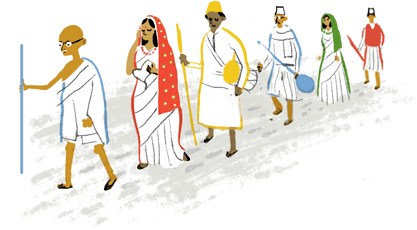
Remembering the Dandi March on India's 69th Independence Day


  COMMENTS FROM INTERNET


Truth always wins . Thank you babasaheb  Dr.B.R. Ambedkar for saving us from gandhi. 
·

Certainly it's fake!!  the voice i think is of classy idiot Dr. Subramanyam swami. If u carefully listen interviews of subby , he's got habit of saying "u see' several time, same thing happens in this audio also. If u listen other speeches of Great legend Dr. Babasaheb Ambekar u'll find the difference in voice. i think it's act to tarnish the image of Mahatma Gandhi.
·


Gandhi had definitely a role to play in India's freedom, but India's freedom wouldnt have been possible without the likes subhash bose as babasaheb mentions here and like a pandit of the highest level , he tells the truth about gandhi without fear, no one had the guts to do that.. 
·

  1. Its Netaji Subhas not Gandhi Satyagraha brought freedom to India - Subramanian Swamy.

    • 8 months ago
    • 35,835 views
    Watch Dr. Subramanian Swamy reveals truth about Netaji Subhas Chandra Bose during a debate on Newsx realted to ...
================================================

MY COMMENT:
BRITISH ALWAYS WANTED TO DIVIDE AND RULE INDIA

WHEN THAT FAILED BRITISH WANTED FIRST  TO DIVIDE INDIA INTO MANY PARTS; BEFORE GIVING FREEDOM TO INDIA

[1]THEY SUCCEEDED IN MAKING PAKISTAN WITH A  BOUGHT OVER ADVOCATE CALLED JINNAH
Sir Syed Ahmad Khan


Sir Syed Ahmad (1817-1898). Starting his career as a clerk in the service of the East India Company in 1837 he finished as a member of the Governor General’s Legislative Council from 1878-1883. He had earned the confidence of the British by his saving many Europeans during the “Mutiny “, so that he was able to make the new rulers acquainted with the Muslim points of view they had been unaware of formerly. His activities comprised three fields, Islam, reconciliation with the British, and relation with the Hindus. As to Islam, after a visit to England in 1869 he became aware that Islamic theology should recover the dynamism it had possessed in the glorious past.His greatest contribution however was the establishment of the Muhammadan Anglo-Oriental College at Aligarh [shows how english rulers were thinking of dividing India into muslim and hindu  even in 1870]


anti-Islamic currents were not universal at the time. At the first session of the Indian National Congress held in 1886 the President said:
“For long our fathers lived and we have lived as individuals only or as families, but henceforward I hope that we shall be living as a nation, united one and all to promote our welfare, and the welfare of our mother-country”.
Sir Syed however did not agree to that, and called the members of the Congress back to reality by saying in one of his speeches on the subject:-

“The proposals of the Congress are exceedingly inexpedient for a country which is inhabited by two different nations….Now suppose that all the English …were to leave India….then who would be rulers of India? Is it possible that under these circumstances two nations---the Mohammedan and Hindu—could sit on the same throne and remain equal in power? Most certainly not. It is necessary that one of them should conquer the other and thrust it down. To hope that both could remain equal is to desire the impossible and the inconceivable.”

Iqbal said at the Session of the Muslim League in 1930 :-
 [by 1930's british increased their efforts to divide India]

“I would like to see the Punjab, North West Frontier Province, Sind and Baluchistan amalgamated into a single state. Self-government within the British Empire or without the British Empire, the formation of a consolidated North Western Indian Muslim state appear to me to be the final destiny of the Muslims, at least of North West India… The Muslim demand ..is actuated by a genuine desire for free development which is practically impossible under the type of unitary government contemplated by the nationalist Hindu politicians with a view to secure permanent communal dominance in the whole of India. Nor should the Hindus fear that the creation of autonomous Muslim states will mean the introduction of a kind of religious rule in such states. For India it means security and peace resulting from an internal balance of power, for Islam an opportunity to rid itself of the stamp that Arabian imperialism was forced to give it, to mobilize its law, its education, its culture, and to bring them into closer contact with its own original spirit and with the spirit of modern times.”

In 1933 a Muslim student at Cambridge, Chaudhari Rahmat Ali, proposed to give Iqbal’s project the name of Pakistan. The name struck the imagination of the masses, and was in general use as late as 1940.

  Muhammad Ali Jinnah

 Quaid-e-Azam Mohammad Ali Jinnah
Iqbal was a poet, but no real politician. In fact the Muslims had at their disposal a qualified politician, Muhammad Ali Jinnah (1876-1948), but he followed for a very long period the unitary point of view adhered to by Nehru and Gandhi until, at last , he was converted to the Pakistan concept in 1937

 Jinnah lost his influence in the National Congress, and, disgusted, he left India to establish himself as a lawyer in London between 1930-1940 
 
[that is the time jinah was converted by british colonial rulers to lead a separate nation called Pakistan ;to divide India-because British thought by dividing India many times according to religion/caste/ruling kings/they can continue to exploit India ]

[2]BUT THEIR EFFORTS TO TAKE AWAY THE SOUTH INDIA IN THE NAME OF DRAVIDIAN LAND WITH THE HELP OF ANOTHER PERSON FAILED
 MEETING -
CAN SEE JINNAH AS THE MAIN BRITISH AGENT IN THIS PHOTO
OTHERS invited by JINNAH  ARE
 AMBEDKAR(RIGHT EXTREME),
DRAVIDA KAZAKAM PARTY RAMASAMI(WHITE HAIR)

THAT PERSON'S NAME WAS PERYAAR RAMASWAMI OF DRAVIDA KAZAKAM PARTY -FROM THIS PARTY LATER D.M.K. AND STILL LATER A.I.AD.M.K. WERE BORN.THOUGH D.M.K. PARTY IN THE BEGINNING CONTINUED D.K. PARTY'S POLICY OF LEAVING INDIA TO FORM A DRAVIDIAN LAND ,LATER THEY DROPPED THAT IDEA  AND POLICY.

[3] IT WAS PART OF THIS POLICY TO WEAKEN INDIA BEFORE GIVING INDEPENDENCE TO INDIA ;BRITAIN CALLED AMBEDKAR TO LONDON ROUND TABLE CONFERENCE

BRITAIN PUT IT AS A SWEET DISH IN FRONT OF AMBEDKAR AND AND GANDHI 
THE SWEET DISH WAS BUT POISONOUS  TO INDIA'S UNITYThe Communal Award was made by the British Prime Minister Ramsay Macdonald on 16 August 1932 granting separate electorates in British India for the Forward Caste, Lower Caste, Muslims, Buddhists, Sikhs, Indian Christians, Anglo-Indians, Europeans and Untouchables (now known as the Dalits) etc.
The 'award' attracted severe criticism from Mahatma Gandhi, the Akali Dal etc.
As a result of the Third Round Table Conference, in November 1932, the then Prime Minister of Britain Ramsay Macdonald gave his 'award' known as the Communal Award. According to it, separate representation was to be provided for the Forward Caste, Lower Caste, Muslims, Buddhists, Sikhs, Indian Christians, Anglo-Indians, Europeans and Dalits. The Untouchables were assigned a number of seats to be filled by election from special constituencies in which voters belonging to the Untouchables only could vote.
The Award was highly controversial and opposed by Mahatma Gandhi, who was in Yerveda jail, and fasted in protest against it. Once the Depressed Classes were treated as a separate community, the question of abolishing untouchability would not arise, and the work of Hindu social reform in this respect would come to a halt. Communal Award was supported by many among the minority communities, most notably the Untouchable leader, Dr. B. R. Ambedkar. After lengthy negotiations, Gandhi reached an agreement with Dr. Ambedkar to have a single Hindu electorate, with Untouchables having seats reserved within it. This is called the Poona Pact. Electorates for other religions like Muslims, Buddhists, Sikhs, Indian Christians, Anglo-Indians, Europeans remained separate.
Akali Dal, the representative body of the Sikhs, was also highly critical of the Award, since only 19% reservation was provided to the Sikhs in Punjab, as opposed to the 51% reservation for the Muslims and 30% for the Hindus.THE DEAL PUT FOREWARD BY BRITAIN WAS INTENDED TO DIVIDE DALITS ;AND FORM A SEPARATE ELECTORATE ;AS A FIRST STEP TO SEPARATE DALITS FROM OTHERS IN INDIA


BUT BECAUSE GANDHI WENT ON A FAST TILL DEATH TO OPPOSE SUCH A MOVE BY BRITAIN THE PLOT FAILED

[4]BRITAIN INSTIGATED MAHARAJAS TO KEEP AWAY FROMJOINING A FREE INDIA

Political integration of India - Wikipedia, the free encyclopedia

https://en.wikipedia.org/wiki/Political_integration_of_India
The early history of British expansion in India was characterised by the .... Bhopal, Travancore and Hyderabad announced that they did not intend to join either dominion. ... The Maharaja of Travancore, for example, definitively abandoned his plans ..... Portugal initiated proceedings before the International Court of Justice to ...

Hyderabad State

From Wikipedia
Nizam decided to keep Hyderabad independent. The leaders of the new Union of India however, were wary of having an independent - and possibly hostile - state in the heart of their new country. Most of the other 565 princely states had already acceded to India or to Pakistan voluntarily. The Indian government was therefore determined to annex Hyderabad into the Indian Union, by force if necessary.
In September 1948, India launched a military operation named Operation Polo, led by Sardar Vallabhbhai Patel, then Minister of Home Affairs and Deputy Prime Minister of India. The Indian Armed Forces invaded the State of Hyderabad and overthrew Nizam.


[3][4]

hyderabad king -NIZAM- and sardar vallabhai patel

Operation Polo - Wikipedia, the free encyclopedia

en.wikipedia.org/wiki/Operation_Polo
Operation Polo, the code name of the Hyderabad Police Action was a military operation in September 1948 in which the Indian Armed Forces invaded the State ...

18th September 1948: Operation Polo is terminated after the ...

www.mapsofindia.com › On this Day
On 18th September 1948, Operation Polo was terminated after the Indian Army accepted the surrender of the Nizam of Hyderabad's army.
===================================================

Junagadh State - Wikipedia, the free encyclopedia

en.wikipedia.org/wiki/Junagadh_State
Junagadh was a princely state ruled by Muslim rulers in British India till its integration in to India in 1948. Mohammad Bahadur Khanji I, who owed allegiance to ...

Junagadh - Wikipedia, the free encyclopedia

en.wikipedia.org/wiki/Junagadh
Jump to Accession to India - [edit]. Main article: Indian Integration of Junagadh. During the period spanning the independence and partition of India and ...


Indian integration of Junagadh - Wikipedia, the free ...

en.wikipedia.org/wiki/Indian_integration_of_Junagadh
On 27 October 1947, Bhutto, as Chief Minister of Junagadh, wrote a letter to Jinnah ... Immediately after the take-over of the state, all rebel Muslim officials of the ...
in-exile, the Aarzi Hukumat (in Urdu: Aarzi: Temporary, Hukumat: Government) of the people of Junagadh. Eventually, Patel ordered the forcible annexation of Junagadh's three principalities. Junagadh's state government, facing financial collapse and lacking forces with which to resist Indian force, invited the Government of India to take control. A plebiscite was conducted in December, in which approximately 99% of the people chose India over Pakistan


  • The story of the integration of the indian states - Hindu ...

    hidf1.files.wordpress.com/.../the-story-of-the-integration-of-the-indian-st...

    The author with the Maharajah of Travancore inaugurating the Travancore-Cochin ... pioneering effort in this direction was made by the Magadhan kings, ...... Nehru andVallabhbhai Patel 1 suggested that, though there was no specific agenda, the ...... I then brought down the discussion to the personal plane, assuring.


  • THE STORY OF THE
    INTEGRATION
    OF THE
    INDIAN STATES
    V. P. MENON
    LONGMANS, GREEN AND CO
    LONDON · NEW YORK · TORONTO

    -----------------------------------------------------------------------------------------------------------------

    CLICK AND READ:-Forgotten Events: How Travancore joined the Union | varnam

    varnam.nationalinterest.in/2003/08/forgotten_events_how_travancor/
    Aug 4, 2003 - Travancore was again in the vortex of a political struggle and the ... [Source: "Kerala's Politics":http://www.keralaspolitics.com/html/history.htm] This series .... not agreeing with total integration (Travancore's sovereignity will be ..


    • Forgotten Events: How Travancore joined the Union

      The present state of Kerala is made up of three princely states, Travancore, Cochin and Malabar. When the British announced their withdrawal from India, the Diwan of Travancore, Sir. CP Ramaswamy Iyer announced that Travancore would establish itself as an independent state and would not join the Indian Union.

      bq. The action of Diwan aroused a bitter controversy inside and outside the State. Travancore was again in the vortex of a political struggle and the Government resorted to a series of repressive measures to meet the situation. One of the highlights of the struggle was a police firing at Pettah, Trivandrum, in which three persons including a student by name Rajendran were killed. A few days after the incident, an unsuccessful attempt was made on Sir C.P. Ramaswamy Iyer’s life when the Diwan was attending a function in the Swathi Thirunal Academy of Music at Trivandrum (July 25, 1947). The Diwan escaped with minor injuries and very soon left the State for good. Immediately after this incident the Maharaja intimated, to Lord Mountbatten, the Governor-General, his decision to accept the Instrument of Accession and take Travancore into the Indian Union. Sir C.P. Ramaswamy Iyer resigned the office of Diwan on August 19, 1947 and was succeeded in that office by P.G.N. Unnithan.
      [Source: "Kerala's Politics":http://www.keralaspolitics.com/html/history.htm] This series is part of “15 days of Independence”:http://www.madhoo.com/archives/002681.php#002681

    [5]:{FROM WIKIPEDIA AND INTERNET}

     NAGA CHIEF PHIZO  WHO WANTED TO SEPARATE FROM INDIA WAS GIVEN ASYLUM IN LONDON


    Naga National Council - Wikipedia, the free encyclopedia

    https://en.wikipedia.org/wiki/Naga_National_Council
    Under the leadership of Angami Zapu Phizo in the 1940s, it unsuccessfully ... It further emphasized local autonomy for the Naga Hills District, and a separate .... 1952 and claimed that 99.9% of the Nagas wanted independence from India. ... Phizo escaped to East Pakistan in December 1956, from where he went to London........................................................................................................

    Within one week Pu Laldenga returned to London and insurgency returned
    to Mizoram.

    [PDF]

    The Secret Agreement : Courtesy of North East Sun, January 15, 2010

    cmmizoram.nic.in/download/files/.../The%20Secret%20Agreement.pdf
    Jan 15, 2010 - Within one week Pu Laldenga returned to London and insurgency returned to Mizoram. What I learnt from my sources in the Ministry of Home ...
    .......................................................................................................... 


     http://tamilnation.co/ltte/98rohan.htm..

     ........................................................................................................................

      IT IS A GREAT DAY TODAY WHEN INDIA IS THRIVING AFTER ALL THE CUNNING PLANS TO WEAKEN INDIA
    SADLY PAKISTAN CONTINUES ANTI INDIA TERRORISM AS A REVENGE FOR DEFEAT IN BANGLADESH


    The Times of India
    India

    Dawood aide Iqbal Mirchi dies in UK


    Dawood aide Iqbal Mirchi dies in UK
    Dawood’s close aide Iqbal Mirchi died of cardiac arrest in London.
    RELATED
    MUMBAI: Fugitive gangster Dawood Ibrahim's close aide Iqbal Memon Merchant alias Iqbal Mirchi, once ranked among the world's top 50 drug lords, died of cardiac arrest in London early on Thursday morning.


    India had twice tried to get him extradited since he fled in the mid-nineties after Maharashtra issued a detention order against him.

    Mirchi, 63, was on a walk near his London house when he suffered a heart attack, his elder brother Kadir Memon, who lives in Mahim, said. He is survived by two wives, Heena Kauser and Hazra, two daughters and a son.

    "Mirchi's death is a big blow to the drugs syndicate, particularly the D gang. It's unfortunate he died before being deported," said Himanshu Roy, joint commissioner of police (crime) said.

    An Interpol red corner notice (an international warrant) was issued against Iqbal Mirchi in 1994 on the Central Bureau of Investigation's request.
    In 1995, officers from the Scotland Yard raided Mirchi's East London home and arrested him on drugs and terrorism charges in connection with the 1993 Mumbai blasts.

    But an extradition request by India was turned down by magistrates.

    Scotland Yard's investigation of Mirchi, which ended in 1999, found no evidence of criminal activity and in 2001, the UK Home Office granted him indefinite leave to remain in the UK.

    Though Mirchi's family claimed that he had only two cases pending against him - one for the murder of his associate Amar Suvarna in 1994 at Kala Ghoda and the other for the seizure of five gunny bags of mandrax from him in Worli in 1995 - the Mumbai police said there were at least three more cases.

    His brother, Kadir Memon, a resident of Mahim, said Mirchi had twice offered to surrender to Indian authorities.

    "Why did the Indian government not accept his offer to surrender in 2004? He had offered to surrender on the condition that he be escorted by the police from the airport to the court as he feared some officers wanted to kill him in a fake encounter," the brother said.

    Mirchi, son of a spice seller from Null Bazaar and a school dropout, began his crime career as a taxi driver transporting drugs concealed in bags of dry red chillies and spices.

    He later became a drug baron and owned a pub in Worli, where he came in touch with politicians, Bollywood actors, police officers and bureaucrats. After he fled India and settled in London, Mumbai police sources said, he invested his ill-gotten money in real estate.

    In 2012, Mirchi was arrested in London and charged with threatening to kill his 41-year-old nephew, Kadir Nadeem.

    The CBI then attempted to revive its extradition request, but the UK's Crown Prosecution Service dropped charges against him because of insufficient evidence.  
    .......................................................................................................


    IT IS A GREAT DAY TODAY WHEN INDIA IS THRIVING AFTER ALL THE CUNNING PLANS TO WEAKEN INDIA
    SADLY PAKISTAN CONTINUES ANTI INDIA TERRORISM AS A REVENGE FOR DEFEAT IN BANGLADESH